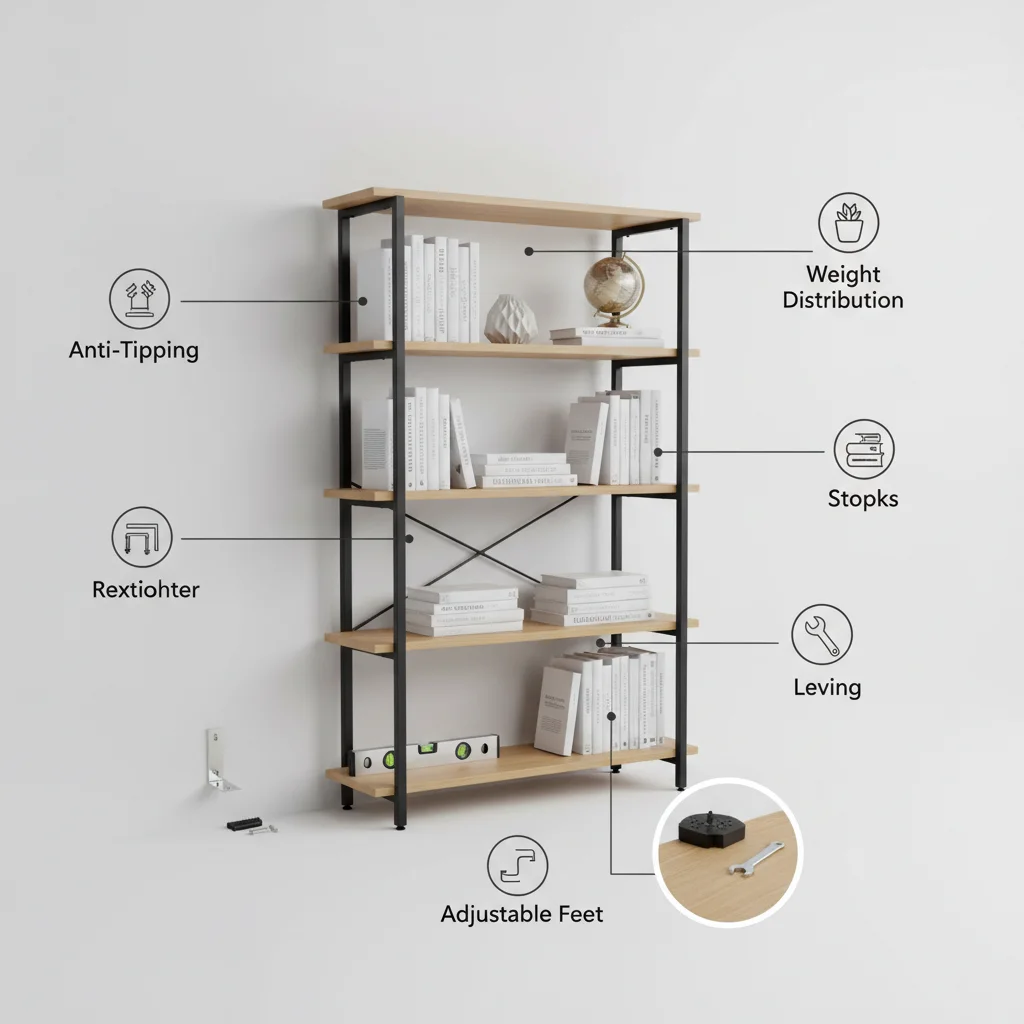
Ensuring bookshelf stability is crucial for the safety of your home and the longevity of your cherished collections. There are five essential factors that contribute significantly to a secure and wobble-free bookshelf, ranging from proper assembly to strategic weight distribution. Understanding these elements will help you prevent accidents and maintain an organized, safe living space.
Foundation and Leveling: The Starting Point for Stability
The journey to a stable bookshelf begins with its foundation. A level floor is paramount; even a slight tilt can compromise the entire structure. Use shims if necessary to correct any unevenness, ensuring all contact points of the bookshelf are firmly on the ground. Beyond the floor, the quality of the bookshelf’s construction materials plays a vital role. Solid wood or high-grade engineered wood offers superior rigidity compared to flimsy particleboard, which can warp or degrade over time, leading to instability.
Proper Assembly and Hardware: Tight Connections Matter
Many stability issues stem from improper assembly. It’s critical to follow the manufacturer’s instructions meticulously, ensuring all screws, dowels, and connectors are tightened securely. Over-tightening can strip threads, while under-tightening leaves components loose and prone to shifting. Regularly check and re-tighten hardware, especially after moving the bookshelf or if you notice any signs of wobbling. The integrity of the hardware itself is also important; opting for bookshelves with robust metal fasteners over plastic ones can significantly enhance long-term stability.
Weight Distribution: Balancing Your Collection
|
Our Picks for the Best Book Shelf in 2026
As an Amazon Associate I earn from qualifying purchases.
|
||
| Num | Product | Action |
|---|---|---|
| 1 | VASAGLE Bookshelf, Tree-Shaped Bookcase with 13 Storage Shelves, Rounded Corners, 9.8”D x 33.9”W x 55.1”H, Rustic Brown ULBC67BXV1 |

|
| 2 | DUMOS 5 Tiers Bookshelf, Classical Book Shelf, Tall Display Shelves in Living Room/Home/Office, Storage Organizer for CDs/Books/Movies, Modern Black |
|
| 3 | NUMENN 5 Tier Bookshelf, Tall Bookcase Shelf Storage Organizer, Modern Book Shelf for Bedroom, Living Room and Home Office, Vintage |
|
| 4 | TVU 5-Tier Wooden Bookshelf, 65 Inch Tall Bookshelf with Storage, Floor Standing Modern Style Display Bookcase for Living Room, Office, Study Room, Entryway, Brown |
|
| 5 | NUMENN Bookshelf, 5 Tier Bookshelves, Home Office Bookcase Shelf Storage Organizer, Free Standing Storage Shelving Unit for Bedroom, Living Room and Home Office, Vintage |
|
| 6 | Furinno JAYA Book Shelf, 5-Tier Bookshelf, Bookcase with Adjustable Shelves, 9.5" x 24.5" x 71.2", for Organization and Storage, for Living Room, Bedroom, Home Office, Blackwood |
|
| 7 | VASAGLE CUSTOS Collection - Bookshelf, 5-Tier Bookcase, Book Shelf, Open Storage Shelf, 9.4 x 23.6 x 52.8 Inches, for Living Room, Home Office, Dinning Room, Cloud White ULBC165T14 |
|
| 8 | Mavivegue Bookcase, 18-Cube Extra Large Book Shelf, DIY Cube Storage Organizer for Bedroom, Living Room, Home Office - Black |
|
| 9 | VASAGLE CUSTOS Collection - Bookshelf, 6-Tier Bookcase, Book Shelf, Open Storage Shelf, 9.4 x 23.6 x 63.3 Inches, for Living Room, Home Office, Dinning Room, Cloud White ULBC166T14 |
|
| 10 | NUMENN Triple Column 5 Tier Bookshelf, Bookcase with 14 Open Display Shelves, Adjustable Rustic Industrial Style Book Shelves, Modern Bookshelves for Bedroom, Living Room and Home Office, Vintage |
|
How you arrange your books and decor has a direct impact on bookshelf stability. Always place heavier items on the lower shelves. This lowers the center of gravity, making the entire unit less likely to tip over. Distribute weight evenly across each shelf rather than concentrating heavy items on one side. Avoid overloading shelves beyond their specified weight capacity, as this can cause bowing, structural fatigue, and eventual collapse. A balanced load ensures that stress is distributed uniformly throughout the bookshelf’s frame.
- Place heaviest books on bottom shelves.
- Distribute weight evenly across each shelf.
- Avoid stacking books too high or too far forward.
- Utilize bookends to prevent items from shifting.
- Do not exceed the manufacturer’s weight limit per shelf.
Anchoring to the Wall: The Ultimate Security Measure
For taller or heavily loaded bookshelves, wall anchoring is not just recommended, it’s often a safety necessity. Most bookshelves come with anti-tip kits, which typically include straps or brackets that secure the top of the unit to a wall stud. If your bookshelf didn’t include one, you can purchase universal anti-tip kits. This simple step can prevent serious injuries, especially in homes with children or pets, by eliminating the risk of the bookshelf toppling forward.
Backing and Cross-Bracing: Enhancing Structural Rigidity
The presence and quality of a bookshelf’s backing can significantly contribute to its stability. A solid, thick back panel, securely fastened to the frame, prevents the bookshelf from racking (swaying side-to-side). Thin cardboard backings offer minimal structural support. For even greater stability, some bookshelves incorporate cross-bracing, often in the form of diagonal wires or wooden slats on the back. These elements create triangular supports, which are inherently strong and resist deformation. If your bookshelf lacks a robust backing, consider adding a custom-cut plywood panel for enhanced rigidity.
