Choosing the right bookshelves for your home goes beyond mere storage; it’s about integrating functionality, style, and personal expression into your living space. With books serving as both treasured possessions and decorative elements, the decision between built-in and freestanding bookshelves has significant implications for your home’s aesthetics, organization, and even its resale value. Both options offer unique advantages and drawbacks, making the selection process a thoughtful journey tailored to your specific needs, budget, and long-term vision. This comprehensive guide will help you navigate the world of bookshelves in 2026, comparing their characteristics, exploring design trends, and providing a detailed buying roadmap to ensure your literary collection finds its perfect home.
Understanding Bookshelf Types
The landscape of bookshelves offers two primary categories: built-in and freestanding. Each category serves distinct purposes and integrates into your home in fundamentally different ways. Understanding these differences is the first step towards making an informed decision.
Built-In Bookshelves
|
Our Picks for the Best Book Shelf in 2026
As an Amazon Associate I earn from qualifying purchases.
|
||
| Num | Product | Action |
|---|---|---|
| 1 | VASAGLE CUSTOS Collection - Bookshelf, 6-Tier Bookcase, Book Shelf, Open Storage Shelf, 9.4 x 23.6 x 63.3 Inches, for Living Room, Home Office, Dinning Room, Cloud White ULBC166T14 |

|
| 2 | Mavivegue Bookcase, 18-Cube Extra Large Book Shelf, DIY Cube Storage Organizer for Bedroom, Living Room, Home Office - Black |
|
| 3 | NUMENN Bookshelf, 5 Tier Bookshelves, Home Office Bookcase Shelf Storage Organizer, Free Standing Storage Shelving Unit for Bedroom, Living Room and Home Office, Vintage |
|
| 4 | NUMENN Triple Column 5 Tier Bookshelf, Bookcase with 14 Open Display Shelves, Adjustable Rustic Industrial Style Book Shelves, Modern Bookshelves for Bedroom, Living Room and Home Office, Vintage |
|
| 5 | Furinno JAYA Book Shelf, 5-Tier Bookshelf, Bookcase with Adjustable Shelves, 9.5" x 24.5" x 71.2", for Organization and Storage, for Living Room, Bedroom, Home Office, Blackwood |
|
| 6 | NUMENN 5 Tier Bookshelf, Tall Bookcase Shelf Storage Organizer, Modern Book Shelf for Bedroom, Living Room and Home Office, Vintage |
|
| 7 | DUMOS 5 Tiers Bookshelf, Classical Book Shelf, Tall Display Shelves in Living Room/Home/Office, Storage Organizer for CDs/Books/Movies, Modern Black |
|
| 8 | VASAGLE CUSTOS Collection - Bookshelf, 5-Tier Bookcase, Book Shelf, Open Storage Shelf, 9.4 x 23.6 x 52.8 Inches, for Living Room, Home Office, Dinning Room, Cloud White ULBC165T14 |
|
| 9 | TVU 5-Tier Wooden Bookshelf, 65 Inch Tall Bookshelf with Storage, Floor Standing Modern Style Display Bookcase for Living Room, Office, Study Room, Entryway, Brown |
|
| 10 | VASAGLE Bookshelf, Tree-Shaped Bookcase with 13 Storage Shelves, Rounded Corners, 9.8”D x 33.9”W x 55.1”H, Rustic Brown ULBC67BXV1 |
|
Built-in bookshelves are custom-designed units seamlessly integrated into your home’s architecture, often appearing as if they are a part of the wall itself. They are permanent fixtures, tailored to precise dimensions and layouts.
Advantages:
Built-in bookshelves offer a truly customized and luxurious aesthetic, elevating any space with a high-end, tailored appearance. They are fully customizable, allowing you to choose exact dimensions, materials, finishes, and hardware to match your taste and home style. Designed to fit perfectly into alcoves, around windows, or on entire walls, they maximize every inch of space, even in oddly shaped rooms, eliminating awkward gaps. This custom approach ensures a unique and personalized storage solution that blends seamlessly with your interior design. Beyond aesthetics, built-ins can significantly boost your home’s value, as buyers often appreciate the integrated storage and thoughtful design. They provide tailored functionality with custom shelving, drawers, and cabinetry designed for your lifestyle, helping maintain tidiness and even concealing electrical systems for a clean look.
Disadvantages:
The bespoke nature of built-in bookshelves comes with a higher cost due to customization, premium materials, and professional installation. These projects almost always require skilled professionals for accurate measurements, design plans, and expert installation, which can lead to longer timelines. Once installed, built-ins are permanent; changes are costly and complicated, as they cannot be easily moved or swapped out. The complex planning involved often necessitates a designer’s input, making it more challenging for everyday homeowners to tackle independently. Their fixed nature means a lack of flexibility if you frequently rearrange your layout or plan to move.
Suitable Spaces and Maintenance:
Built-in bookshelves are ideal for “forever homes” where permanence and a polished aesthetic are desired. They excel in small or oddly shaped rooms, alcoves, around fireplaces, windows, and in home offices, transforming neglected areas into elegant, functional storage. They are perfect for creating impressive library walls. Maintenance typically involves regular cleaning, and because they eliminate gaps, they tend to stay cleaner than freestanding units. However, repairs to integrated parts may require professional assistance.
Freestanding Bookshelves
Freestanding bookshelves are independent, movable furniture pieces that can be placed anywhere in a room. They come in a wide array of pre-made designs and materials, offering flexibility and ease of acquisition.
Advantages:
Freestanding bookshelves are easily accessible from countless retailers and online shops, often with shorter lead times than custom built-ins. Their primary advantage lies in flexible placement; you can move, rearrange, or replace them as your needs and tastes evolve. Many freestanding pieces are DIY-friendly, often requiring minimal assembly without professional help, making them a more cost-effective option upfront. They offer unmatched convenience, affordability, and design variety, ranging from vintage finds to high-end designer brands. Their fast turnaround means you can purchase one, place it in your space, and immediately enjoy your new storage.
Disadvantages:
While convenient, freestanding bookshelves often leave wasted space due to standardized sizing, particularly in rooms with unique dimensions or architectural features. They may also lack the stability of built-in alternatives, especially with heavier loads, and store-bought options can sometimes sacrifice quality for portability. Customization options are typically limited, making it harder to achieve a fully integrated, cohesive look unless the piece is custom-made. Unlike built-ins, they are generally less effective at increasing a home’s resale value.
Suitable Spaces and Maintenance:
Freestanding bookshelves are ideal for renters, individuals who frequently update their interiors, or those who prioritize affordability and ease of access. They suit flexible layouts and smaller spaces, especially compact units or multi-purpose furniture. Maintenance is straightforward; they are easy to move and clean around, and individual pieces can often be repaired or replaced with less hassle.
Corner Bookshelves
Corner bookshelves, whether built-in or freestanding, are specifically designed to maximize often-underutilized corner spaces.
Advantages:
These shelves are excellent for optimizing vertical and horizontal space in corners, providing practical storage where other furniture might not fit. They can enhance a room’s aesthetic, adding a modern touch and drawing the eye upward, which can make spaces feel larger. Corner shelves are versatile, fitting rooms of any size, and offer flexibility to showcase personal items while blending function with style.
Disadvantages:
Careful planning is crucial to avoid oversized or bulky units that might block walkways or make the area feel cramped. Deep shelves can make items hard to reach, while excessively shallow ones limit storage capacity. Proper installation and consideration of the wall’s condition are vital for safety and stability, especially for wall-mounted options.
Optimization:
To make the most of corner spaces, consider floor-to-ceiling shelving, narrow bookcases that fit between existing furniture, or L-shaped and triangular designs. Floating corner shelves can create a clean, open look, but require strong wall anchors for heavier items.
Comparison of Bookshelf Types
To simplify your decision, here’s a detailed comparison of built-in, freestanding, and corner bookshelves across various crucial criteria.
| Criterion | Built-In Bookshelves | Freestanding Bookshelves | Corner Bookshelves |
|---|---|---|---|
| Price | High (due to custom design, materials, installation) | Low to Moderate (readily available, no installation) | Moderate (can be custom or off-the-shelf) |
| Durability | High (custom-built, often premium materials) | Varies (store-bought can sacrifice quality) | High (if properly installed and constructed) |
| Aesthetics | Luxe, custom, seamless, integrated, high-end look | Flexible, wide variety of styles, can look less cohesive | Space-optimizing, can be modern or traditional |
| Space Utilization | Maximizes every inch, perfect fit, no wasted space | May leave wasted space due to standard sizing | Maximizes often-unused corner areas |
| Flexibility | Low (permanent fixture, difficult to move/change) | High (easy to move, rearrange, replace) | Moderate (can be moved if freestanding, fixed if built-in) |
| Installation Ease | Requires professional installation, complex, long timelines | DIY-friendly, quick setup | Varies (DIY for freestanding, professional for built-in) |
| Home Value Add | Significantly increases property value | Minimal impact on home value | Can add value if custom-built and well-designed |
| Customization | Full customization (dimensions, materials, features) | Limited customization (pre-made designs) | Moderate (can be customized for corner, limited design) |
Buying Guide: Selecting Your Perfect Bookshelf
Choosing the ideal bookshelf involves a thoughtful assessment of your needs, your space, and your personal style.
Determine Your Usage Needs
Before diving into materials and styles, consider the practical aspects:
- Quantity of Books: How many books do you need to store? This will dictate the size and capacity required.
- Space Dimensions: Measure your available space meticulously. Consider height, width, and depth to ensure a perfect fit, especially for built-ins or corner units.
- Interior Style: Your bookshelf should complement your home’s existing decor. Do you prefer modern, traditional, industrial, or minimalist?
- Long-term vs. Temporary: Are you looking for a permanent fixture in your “forever home” or a flexible solution for a rental or evolving space?
Choosing the Right Material
The material of your bookshelf dictates its durability, aesthetic, and price.
- Solid Wood: Options like oak, maple, walnut, sheesham, and ash offer exceptional strength, durability, and natural beauty. They are resistant to sagging and can be refinished, making them a long-term investment for heavy-duty storage. However, they are typically more expensive, heavy, and can be sensitive to moisture.
- Plywood: An engineered wood product, plywood is strong, stable, and more cost-effective than solid wood. It’s less prone to warping or cracking and performs well for heavy books. It often requires veneer or finish to cover unattractive edges.
- MDF (Medium-Density Fiberboard): MDF is affordable with a smooth surface, making it excellent for painted finishes. However, it’s less durable than solid wood or plywood, susceptible to moisture, and can sag under heavy weight. It’s best suited for lighter books and decorative items.
- Metal (Steel, Aluminum): Metal bookshelves provide superior strength, durability, and are low maintenance. They offer a modern, industrial look and are excellent for high-capacity storage, even in humid environments. Some may find their aesthetic to be cold or prone to scratches.
- Glass/Acrylic: These materials offer a lighter, more open feel, allowing light to pass through. However, they are generally more fragile and often more expensive than other options, best suited for lighter display items rather than heavy book collections.
Style and Size Considerations
The style and size of your bookshelf should align with your aesthetic preferences and practical requirements.
- Built-In Bookcases: These are custom-sized to fit your space perfectly, offering integrated designs like wall-to-wall shelving or units built around architectural features.
- Freestanding Bookcases: Available in standard sizes, freestanding units come in diverse styles, including traditional vertical units, ladder shelves, library wall systems, floating shelves, and corner units.
- 2026 Design Trends: Current trends lean towards slimline floating shelves, adjustable track shelving for dynamic organization, and mixed-depth shelving that combines practical storage with display areas. Cantilevered units offer a visually light presence, while vibrant, colorful painted shelves are making a bold statement, turning storage into a focal point. Backlit shelves also add a warm ambiance and highlight collections.
Budget and Brands
Your budget will significantly influence your choice.
- Built-In Costs (2026 Estimates): Expect a wide range, from $400 – $1,500+ for basic units to $2,500 – $6,000 for average residential installations, and $6,000 – $12,000+ for high-end or custom projects. Luxury installations can exceed $15,000 – $20,000. Labor typically ranges from $70-$150 per hour. Material costs per linear foot also vary: Plywood $150-$600, Hardwood $500-$1,200, MDF $150-$400, Metal $450-$850, and Glass $750-$1,200.
- Freestanding Brands: Many reputable brands offer quality freestanding bookshelves. Popular choices include Sauder, Altra Lawrence, Project 62, Red Barrel Studio, Kunigunde, NovaSolo, Euro Style, Castlery, West Elm, and Crate & Barrel. Researching these brands can provide a starting point for reliable and stylish options across various price points.
Top Picks: Suggested Bookshelf Styles
Here are a few popular and effective bookshelf styles to consider for different needs and aesthetics:
- The Modern Library Wall (Built-In): For those seeking a dramatic, high-capacity solution, a floor-to-ceiling built-in library wall transforms a room. Often featuring integrated lighting and diverse shelving depths, these units are ideal for extensive collections and create a sophisticated focal point.
- Sleek Floating Shelves (Freestanding/Built-In): Perfect for minimalist or contemporary spaces, floating shelves offer a light, airy aesthetic without occupying floor space. They work well for displaying curated collections or in smaller rooms where visual clutter is a concern.
- Industrial Metal and Wood Unit (Freestanding): Combining the strength of metal frames with the warmth of wood, these units suit industrial or modern rustic interiors. They are robust, capable of holding heavy loads, and offer a distinct character.
- Corner Ladder Bookshelf (Freestanding): A smart choice for optimizing small or awkward corners, ladder bookshelves lean against the wall, providing graduated shelving that is both functional and visually interesting. They offer a casual yet chic look.
- Integrated Window Seat Bookcase (Built-In): This dual-purpose design maximizes space around a window, offering both comfortable seating and valuable book storage. It creates a cozy reading nook and adds architectural interest.
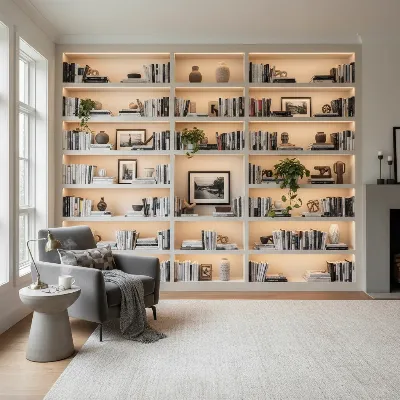 Modern built-in bookshelves with integrated lighting in a contemporary living room.
Conclusion
The choice between built-in and freestanding bookshelves ultimately depends on a confluence of factors: your budget, available space, aesthetic preferences, and how long you plan to stay in your current home. Built-in units offer unparalleled customization, seamless integration, and value appreciation, making them a superb long-term investment for a tailored and polished aesthetic. Freestanding bookshelves, conversely, champion flexibility, affordability, and ease of adaptation, ideal for those who value mobility and versatility. Corner solutions, whether built-in or freestanding, offer clever ways to maximize often-overlooked spaces.
No matter your choice, thoughtful consideration of materials, style, and functional needs will ensure your bookshelf not only organizes your literary treasures but also enhances the beauty and harmony of your home. Which type of bookshelf will best bring your vision to life?
Frequently Asked Questions
Can freestanding bookshelves sag over time?
Yes, freestanding bookshelves, especially those made from less durable materials like particleboard or thin MDF, can sag over time, particularly under heavy loads. To prevent this, opt for thicker shelves made of solid wood or high-quality plywood, and ensure they are reinforced with proper supports.
What is the best material for heavy book collections?
For heavy book collections, solid hardwoods like oak, maple, or walnut, as well as furniture-grade plywood, are highly recommended due to their superior strength and resistance to bowing. Metal bookshelves also offer excellent weight-bearing capacity and durability.
Is it cheaper to DIY or hire a professional for built-in bookshelves?
DIY built-in bookshelves can be cheaper for material costs, ranging from $500 to $2,000, but require intermediate to advanced carpentry skills and tools. Hiring a professional is more expensive (average $2,500-$6,000) but ensures proper installation, structural integrity, and a polished finish, avoiding costly mistakes.
How can I make my small room look larger with bookshelves?
To make a small room look larger, utilize vertical space with tall, slim bookshelves or floating shelves. Choose light-colored materials and open designs to minimize visual clutter. Avoid thick, dark units, and consider corner shelves or multi-functional furniture to keep floor space clear.
How do I maintain and clean my bookshelves?
Regular dusting with a soft, dry cloth is essential to prevent dust buildup on both books and shelves. For wooden shelves, occasional polishing with a wood-safe cleaner can maintain their luster. Metal and glass shelves can be wiped with a damp cloth and then dried. Ensure proper ventilation to avoid moisture damage, especially for wood.
